Build with Gemma: Humor Genome NYC

Results and Project Showcase

Seven projects explored how Gemma can create, understand, organize, and support humor, comedy, audiences, and performance.

7
submissions
3
award winners
2
honorable mentions
$1,500
awarded

What the community built

Seven approaches to humor.

Humor depends on timing, context, culture, surprise, audience, and shared understanding. This hackathon invited builders to explore what open models can contribute to that space.

The submissions approached the challenge through humor explanation, audience simulation, performance feedback, creative tools, contextual experiments, and broader humor-intelligence systems.

Official award winners

Three projects, three official tracks.

The original three tracks remain the official awards. Each winner is also recognized for the specific contribution that distinguished the project.

Official award Humor Creation Award
$500
Video not loading? Watch the demo on YouTube .

Creative Humor Tooling

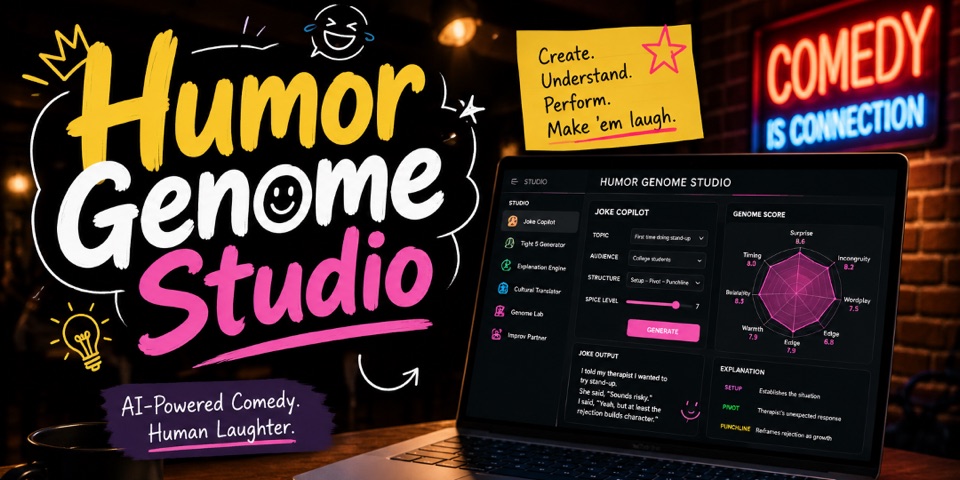
Humor Genome Studio

By Aryan Yadav

A modular browser workbench for creating, explaining, adapting, analyzing, and performing humor through dedicated tools.

How Gemma is used

Task-specific structured prompts call Gemma through Google AI Studio; a shared pipeline validates, retries, repairs, and can critique outputs across modules.

Why it was recognized

Recognized for bringing multiple humor tasks into one modular, approachable creative workbench powered by a shared Gemma workflow.
Official award Humor Understanding Award
$500
Video not loading? Watch the demo on YouTube .

Humor Explanation

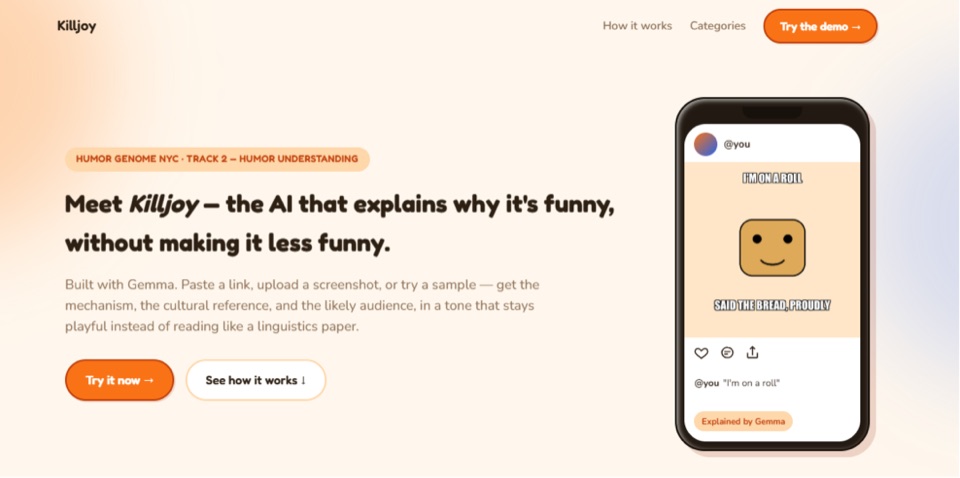
Killjoy: the AI that explains why it's funny

By Musliadi

An interactive meme explainer that identifies a joke's mechanism, cultural reference, likely audience, and the cost of explaining it.

How Gemma is used

Sends the image directly to Gemma 4 in one multimodal call and requests five structured fields covering mechanism, explanation, context, audience, and a self-aware “funniness lost” score.

Why it was recognized

Recognized for making humor mechanics and context easier to understand through a focused, approachable meme-explanation experience.

Official award Human + AI Performance Award
$500
Video not loading? Watch the demo on YouTube .

Audience Feedback for Performers

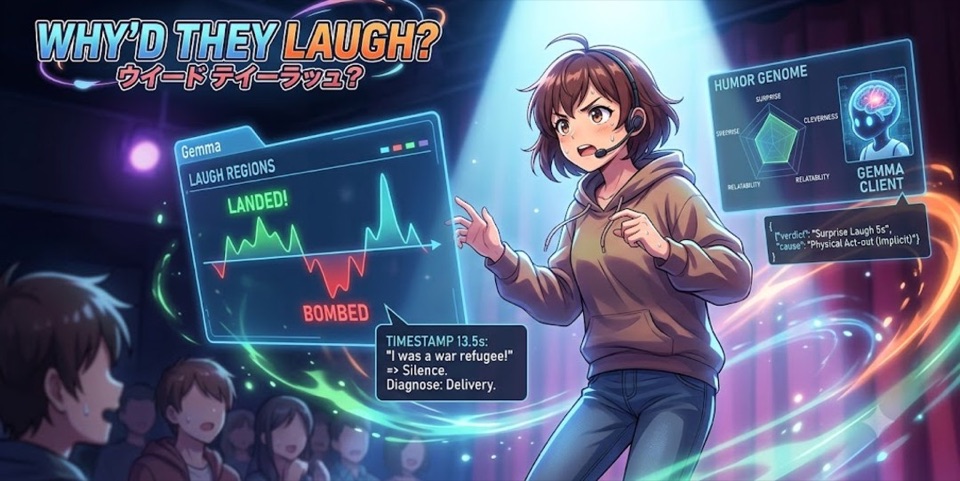
Why'd They Laugh? - An Audience Focused Feedback System

By okkotsu_senpai

A performance-feedback prototype that analyzes recordings or text, compares detected audience laughter with Gemma’s predicted beats, and returns structured, timestamped notes.

How Gemma is used

Gemma performs structured joke decomposition, audience simulation, frame-aware clip reasoning, and targeted rewriting; audio signal processing supplies the measured laugh regions.

Why it was recognized

Recognized for connecting Gemma’s analysis with observed audience laughter to produce practical, beat-by-beat feedback for performers.

Honorable mentions

Focused ideas worth recognizing.

Two additional submissions stood out for what they made visible about model reasoning, human feedback, and audience context.

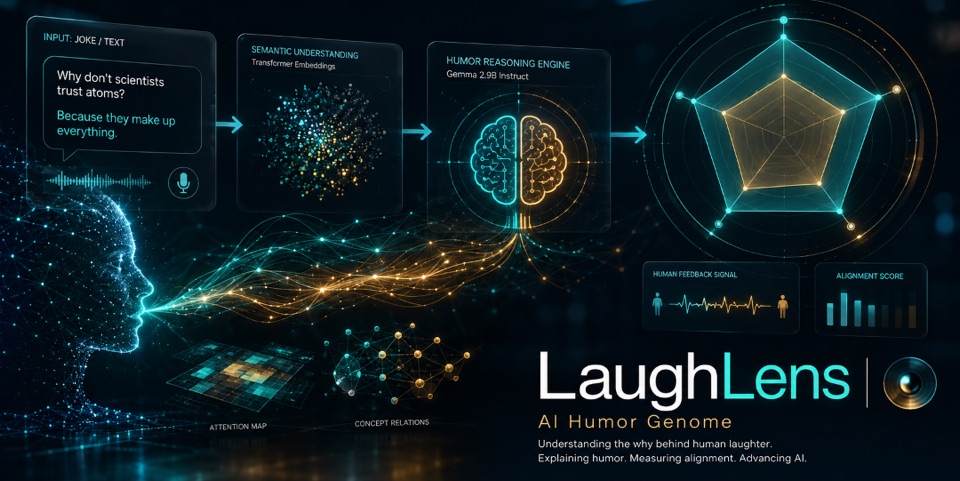
LaughLensAI cover showing joke analysis flowing into a radar chart
Honorable mention

LaughLensAI

By Abhishek Gaduputi

Humor Intelligence

A text-joke analysis tool that visualizes structural dimensions as a Humor Genome and compares Gemma's hypothesis with anonymous human ratings.

How Gemma is used Uses Gemma 4 through the Google Gen AI SDK to return schema-validated analysis across humor dimensions; the results are presented as model hypotheses and compared with human feedback.

Why it was recognized Recognized for exploring where a model’s structural reading of a joke aligns with—or diverges from—human feedback.

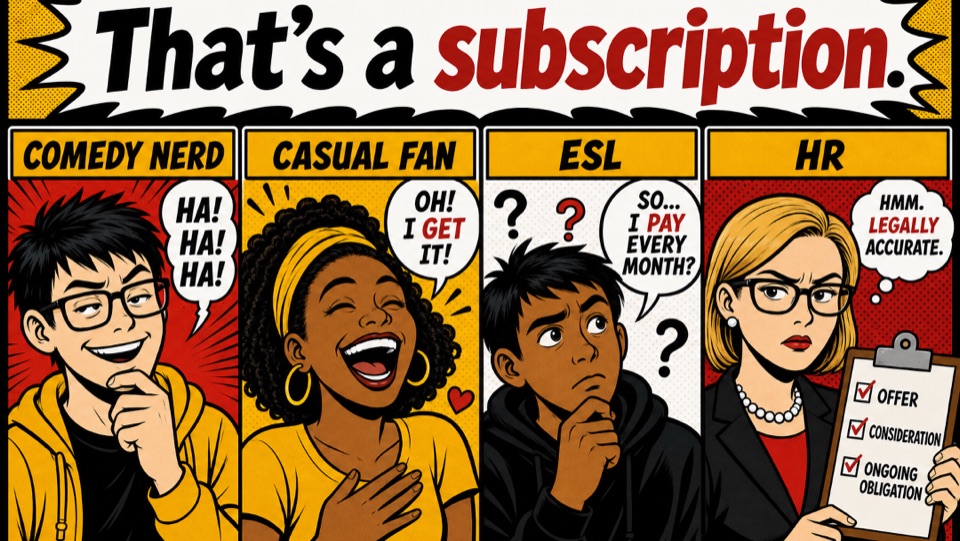
Comic-style Room Sense cover showing four audience reactions to the same joke
Honorable mention

Room Sense Text: Same Joke, Four Gemma Audiences

By samuel tan

Audience Context Experiment

A clonable Kaggle notebook that shows how one joke is received by four simulated audience personas and rewrites it for a colder room.

How Gemma is used Runs Gemma 4 through llama.cpp to produce four audience reactions, explain the joke’s structure and risks, and rewrite it for a selected colder audience.

Why it was recognized Recognized for a focused comparison that makes audience context—and disagreement around the same joke—visible.

Project directory

All Seven Submissions

Every submission is included here in alphabetical order with the same card structure. Award status adds context without changing the space given to each project.

Crowdwork Copilot cover with illustrated New York references

Crowdwork Copilot: Simulate Real-Time Audience Reactions to Your Stand-Up Jokes

By Cary Chan

A text-based audience simulator that returns structured reactions from three audience personas to help comedians test and revise stand-up material.

Humor Genome Studio cover showing its dark multi-tool interface Official award winner

Humor Genome Studio

By Aryan Yadav

A modular browser workbench for creating, explaining, adapting, analyzing, and performing humor through dedicated tools.

Killjoy cover showing a sample meme in a phone mockup and humor explanation interface Official award winner

Killjoy: the AI that explains why it's funny

By Musliadi

An interactive meme explainer that identifies a joke's mechanism, cultural reference, likely audience, and the cost of explaining it.

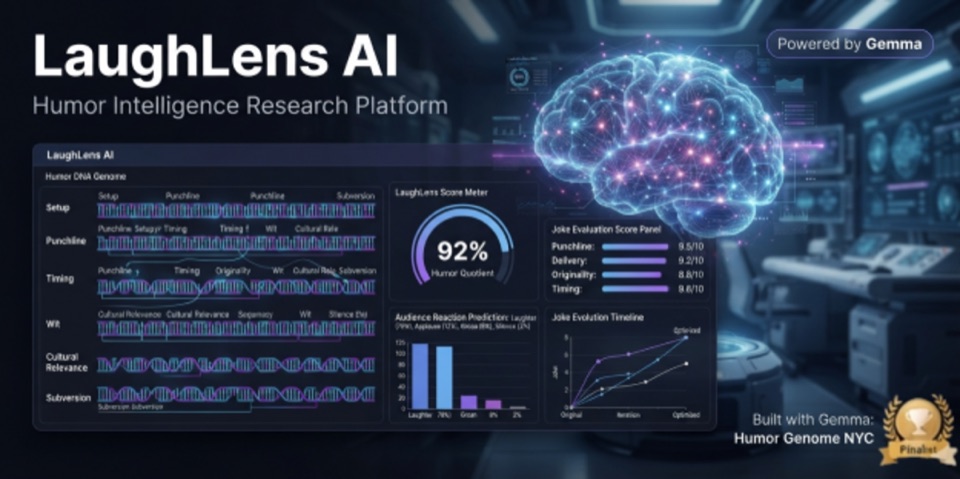
LaughLens AI cover showing its humor evaluation dashboard

LaughLens AI: Gemma Powered Humor Intelligence Platform

By Warrior

A humor-intelligence research concept centered on generating jokes, evaluating humor quality, and examining patterns such as setup, surprise, context, timing, and audience perception.

LaughLensAI cover showing joke analysis flowing into a radar chart Honorable mention

LaughLensAI

By Abhishek Gaduputi

A text-joke analysis tool that visualizes structural dimensions as a Humor Genome and compares Gemma's hypothesis with anonymous human ratings.

Comic-style Room Sense cover showing four audience reactions to the same joke Honorable mention

Room Sense Text: Same Joke, Four Gemma Audiences

By samuel tan

A clonable Kaggle notebook that shows how one joke is received by four simulated audience personas and rewrites it for a colder room.

Why'd They Laugh? cover showing an illustrated performer beside laughter analysis charts Official award winner

Why'd They Laugh? - An Audience Focused Feedback System

By okkotsu_senpai

A performance-feedback prototype that analyzes recordings or text, compares detected audience laughter with Gemma’s predicted beats, and returns structured, timestamped notes.

Review approach

How Projects Were Reviewed

Projects were considered based on meaningful use of Gemma, relevance to humor and comedy, the quality and clarity of the demonstrated prototype, and what the project revealed or enabled.

The original three tracks remain the official awards. Each winner is also recognized for the specific contribution that distinguished the project within the broader challenge.

  • Meaningful use of Gemma
  • Connection to humor, comedy, audience, or performance
  • Working demo or clear prototype
  • Clarity and originality
  • What the project demonstrated or taught

The full builder community

Seven Projects, One Starting Point

Thank you to every participant who turned an idea about AI and humor into a concrete submission. Together, these seven projects form the first public collection produced through Build with Gemma: Humor Genome NYC.